If something is still unclear after reading these FAQs, just get in touch and we can have a chat.
A health coach helps you improve your wellbeing by working with the habits and patterns that shape how you feel each day. These often include sleep, stress, nutrition, movement, recovery, and the pace of daily life.
During coaching sessions we look at what is happening in your life and body right now. From there we identify small adjustments that could make a meaningful difference over time. Many clients work on improving sleep routines, stabilising energy levels, managing stress more effectively, or building healthier relationships with food and movement.
Health coaching focuses on practical change. The goal is to help you build habits that support your health naturally rather than relying on short term motivation.
A health coach and a therapist support wellbeing in different ways. Therapy focuses primarily on emotional healing, mental health conditions, and exploring past experiences that influence psychological wellbeing.
Health coaching focuses more on everyday lifestyle patterns that affect physical and emotional health. This includes areas such as sleep, stress regulation, energy levels, nutrition, movement, and daily routines.
Therapy often looks deeply at past experiences, while health coaching usually focuses on the present and how small changes can improve your day to day life moving forward. For many people the two approaches complement each other well. Someone may work with a therapist for emotional support while also working with a health coach to improve lifestyle habits that support overall wellbeing.
No, you do not need to be unhealthy to work with a health coach. Many people seek health coaching simply because they want to feel better in their body and life.
You might already exercise, eat well, and care about your health, yet still feel tired, stressed, or slightly out of balance. Health coaching can help you understand what is happening and make thoughtful adjustments that improve how you feel.
Some clients come with specific concerns such as sleep problems, burnout, hormonal changes, or persistent fatigue. Others simply feel that something in their lifestyle needs to shift.
Health coaching is often most helpful for people who are proactive about their wellbeing and want guidance, perspective, and structure.
Health coaching can support many aspects of wellbeing because health is influenced by a wide range of factors. Many clients work on improving stress resilience, sleep quality, energy levels, nutrition, and movement habits.
We may also explore your relationship with food, patterns of burnout or overwhelm, hormonal changes such as perimenopause, or pain and injuries that affect confidence in movement.
Lifestyle factors like work pressure, boundaries, recovery time, and the mental load of family life can also play a significant role in health.
Rather than trying to change everything at once, we focus on a small number of priorities and work through them gradually. Often the most meaningful results come from making small adjustments in the right areas.
Health coaching sessions usually last 45 to 60 minutes and are held online by video. In some cases sessions may take place in person if you are local.
In the first session we explore your current health, lifestyle, and the challenges you are experiencing. This helps us understand how factors such as stress, sleep, movement, and nutrition may be interacting.
From there we identify one or two practical areas to focus on and agree on small next steps. The aim is not to overwhelm you with tasks but to begin experimenting with realistic changes.
Follow up sessions review what you tried, what worked, and what you learned. Over time those small adjustments build into healthier and more sustainable routines.
Health coaching can be very valuable when you feel stuck between knowing what you should do for your health and actually doing it consistently.
Information about health is everywhere, but applying that knowledge in real life can be difficult when you are balancing work, family responsibilities, and stress. Health coaching provides structure, accountability, and an outside perspective.
Many clients notice improvements in sleep, energy levels, stress resilience, and their relationship with food and movement. Just as importantly, they develop a clearer understanding of their body and how to support it.
Health coaching is not a quick fix. It works best for people who are curious about their wellbeing and willing to experiment with small changes over time.
Health coaching may be a good fit if you feel stuck, overwhelmed, or out of balance and want practical support to improve your wellbeing.
Many clients come because they want to better understand their body, manage stress more effectively, improve sleep, or create healthier daily routines. Others simply feel that something in their lifestyle needs to change but are unsure where to begin.
Health coaching is not suitable for medical diagnosis, medication changes, or acute mental health crises. It also does not involve strict diets or rapid weight loss programmes.
If you are unsure whether health coaching is right for you, a discovery call is a simple way to talk through your situation and see whether the approach feels helpful.
The results of health coaching look slightly different for each person because everyone’s lifestyle and health history are unique. However, many clients experience similar changes over time.
Common improvements include better sleep, steadier energy levels, reduced stress, and a healthier relationship with food and movement. Many people also develop greater awareness of how their body responds to stress, recovery, and lifestyle habits.
Health coaching focuses on sustainable change rather than quick fixes. In the first few weeks people often notice small shifts in awareness and daily routines. Over several months those shifts can become stable habits that support long term wellbeing.
Health coaching does involve creating plans, but they are always developed together rather than handed down as strict instructions.
Every person’s body, lifestyle, and responsibilities are different, so there is rarely a single perfect solution. Instead we explore what has worked for you in the past and design experiments that fit your real life.
The focus is usually on small adjustments rather than dramatic changes. When the right shift happens in the right place, even a small change can improve sleep, energy, or stress levels.
The coaching process is collaborative. My role is to provide knowledge and guidance while you bring your own experience and feedback.
My background combines sport, science, and clinical experience. I hold a Bachelor of Science in Physiological Sciences from the University of Arizona and trained as a physiotherapist in Germany, where I worked with patients recovering from complex neurological and physical conditions.
I am also a certified Health Coach through the Institute for Integrative Nutrition with a focus on lifestyle and women’s health.
Earlier in my career I competed internationally as a professional golfer, including winning the Junior World Championship and playing on the LPGA Futures Tour. That experience gave me a deep understanding of performance, injury, recovery, and the physical and mental demands placed on the body.
Today my coaching brings together these experiences to support people in improving their health and resilience.
The programmes provide different levels of support depending on your needs and goals.
The one month programme is a short starting point for people who want to focus on a specific issue such as sleep, stress management, or establishing healthier routines.
The three month programme allows more time to build consistent habits and understand patterns in stress, energy, sleep, and daily lifestyle.
The six month programme offers deeper support for more complex situations such as burnout, hormonal changes, persistent injuries, or major life transitions.
Starting with a shorter programme can help you experience coaching first, and it is always possible to continue the work together if longer support feels helpful.
Between sessions you will have access to a secure online client portal where you can view notes, resources, and reflection exercises related to your coaching.
You may also receive simple tools or worksheets that help you observe patterns in areas such as stress, sleep, energy, or nutrition. These are designed to support awareness without creating unnecessary pressure.
For short questions or quick check ins you can also reach out through WhatsApp messaging.
Together we decide what level of accountability and support feels helpful for you. Some clients appreciate regular check ins while others prefer a lighter approach and simply knowing support is available when needed.
It is important to understand the boundaries of health coaching so that you receive the right kind of support.
A health coach does not diagnose medical conditions, prescribe medication, or interpret laboratory results independently. Health coaching also does not replace psychotherapy, trauma therapy, or crisis mental health care.
Health coaching is not designed to treat eating disorders or provide extreme diets, detox programmes, or rapid weight loss solutions.
If it becomes clear during our work that additional medical or psychological support would be beneficial, I will encourage you to connect with the appropriate professionals. Coaching can often continue alongside those providers while focusing on daily habits and lifestyle changes.

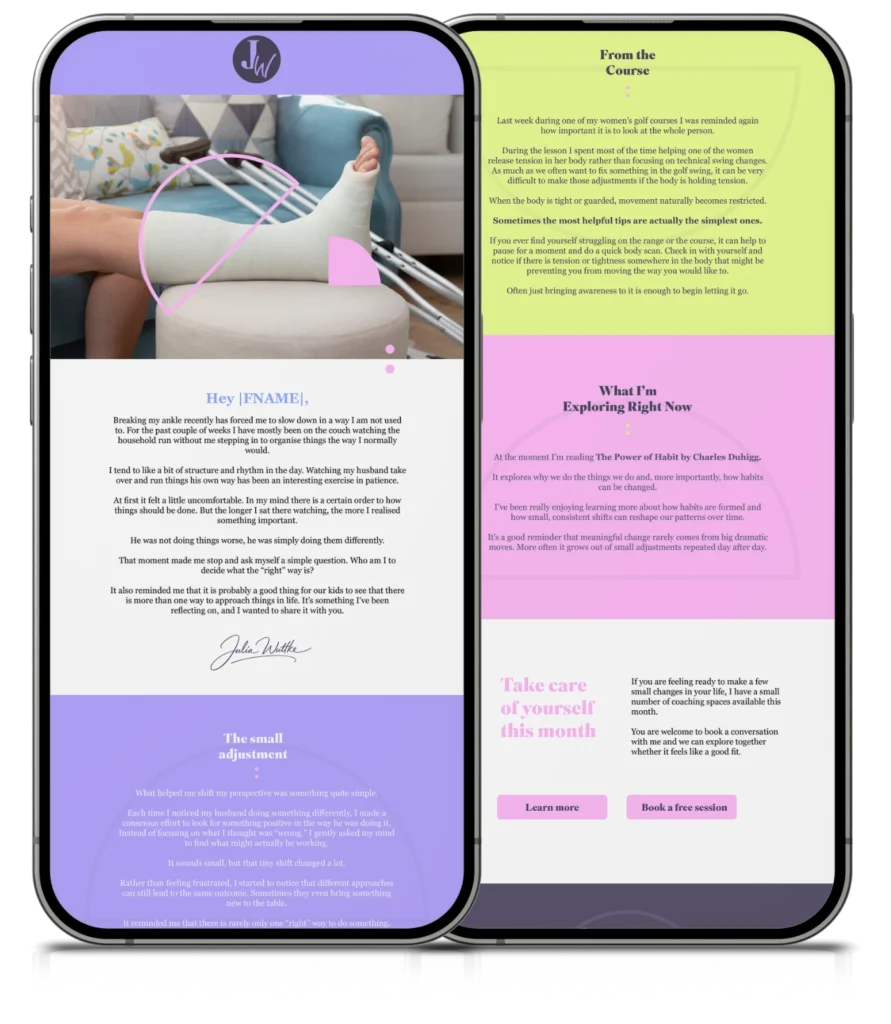
Every fortnight I send something your way.
It might be a simple idea, something I’ve been reflecting on, or a small shift that could make a difference in your day to day. It could also be something I’m exploring myself, whether that’s around health, habits, or how we move through life.
I take the time to think about what I share, so it feels useful, relevant, and worth reading.
If that sounds like something you’d like to receive, you’re very welcome to join.
If you’re unsure where to begin, a simple conversation is often the best place to start.
In a free consult, we talk through where you are now, what you are noticing in your body and performance, and what support could look like moving forward.